
Skip to content
Western Origins

Maybe the West is older...

...and the steppe was a stage.

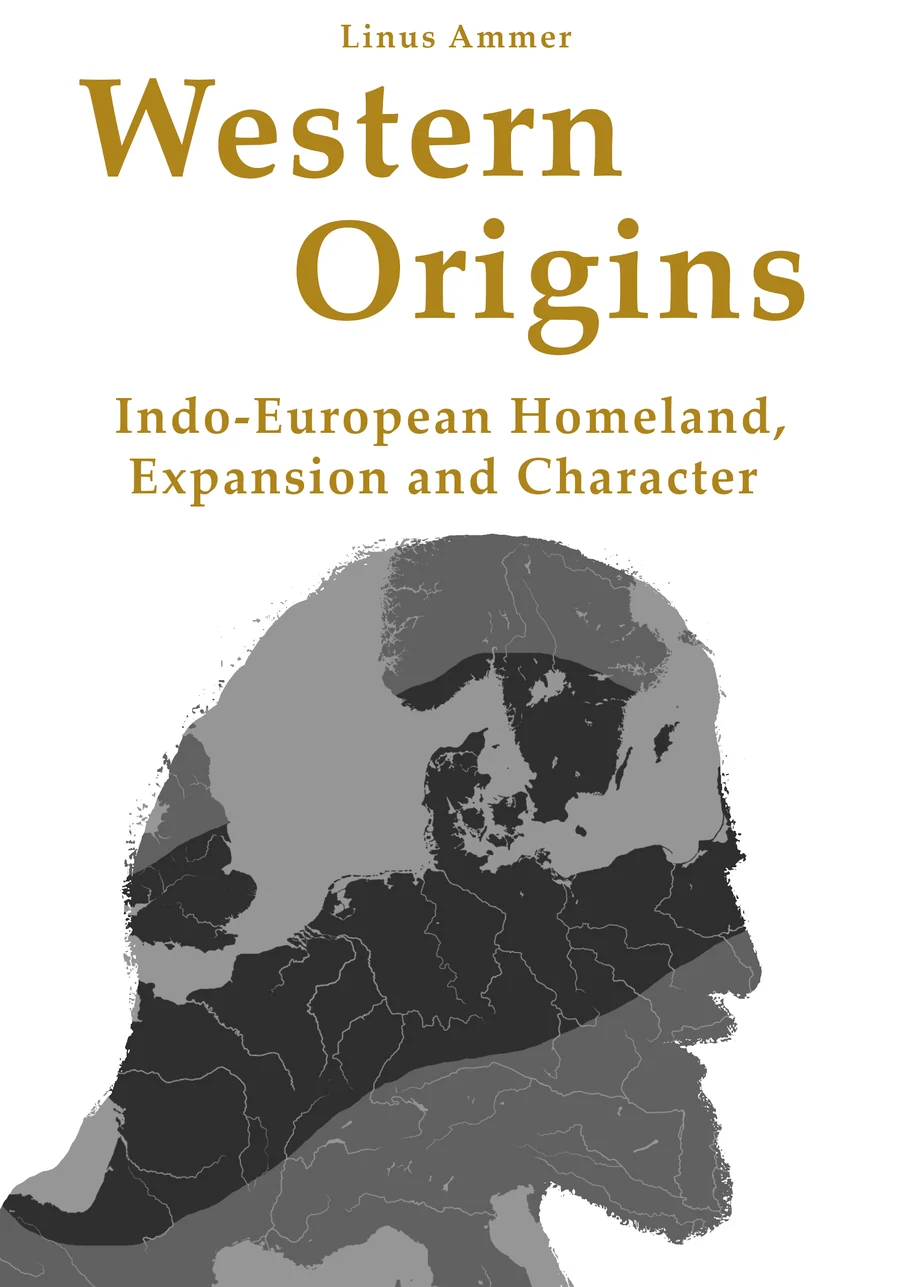
Front cover of Western Origins by Linus Ammer: the title in gold above a human head in profile, filled with a map of the North Sea, the Baltic and the North European Plain.
  • Dispatched May 2027
  • Cancel any time
  • Secure Stripe payment

About

All arguments in one book

The debate is old and decades worth of strong arguments are finally underpinned by data aggregation, maps and genetic findings.

John Day, like many other historians, had concluded that Indo-Europeans used to be of Nordic appearance, blonde and blue-eyed. This has brought the Steppe Hypothesis into a recent crisis, as genetics proved the Yamnaya people to have dark features and Western Hunters light features.

The pressure increased when it became clear that the famous Corded Ware culture that Indo-Europeanized Western Europe, is not a descendant of the Steppe but rather something like its bigger cousin.

Present-day distribution of eye and hair pigmentation

After Mallory, Encyclopedia of Indo-European Culture (1997)
Present-day distribution of eye and hair pigmentation

After Mallory, Encyclopedia of Indo-European Culture (1997)
For a long time Western and Northern Europe have been discussed as homeland of the earliest Indo-Europeans. A lot of research and evidence has been brought up in different disciplines.

The author gathers all of these traces and reconstructs what lies beyond the commonly known Steppe Hypothesis. It turns out recent academia, publication and press have favoured to portray things in a tendentious way, trying to downplay European autochtony and genetic population differences.

Maglemose successor cultures from 6000 BC

After Zalizniak, Mesolithic origins of the first Indo-European cultures in Europe according to the archaeological data (2016), and Klejn, Do the Indo-European languages of Europe stem from the steppe people of the Yamnaya culture? (2017)

Maglemose successor cultures from 6000 BC

After Zalizniak, Mesolithic origins of the first Indo-European cultures in Europe according to the archaeological data (2016), and Klejn, Do the Indo-European languages of Europe stem from the steppe people of the Yamnaya culture? (2017)

The author then traces the Indo-European expansion from the Stone and Bronze Ages to the peoples of antiquity. The waves of expansion are illustrated through numerous maps.

An overview of the epochs reveals the step-by-step process of Indo-Europeanization — extending to the present day, where the language family covers half the Earth's land surface.

Indo-Aryan invasion (1800–1200 BC)

After Mallory, Encyclopedia of Indo-European Culture (1997)

Indo-Aryan invasion (1800–1200 BC)

After Mallory, Encyclopedia of Indo-European Culture (1997)

What kind of people were the Indo-Europeans? What underlying characteristics, traits, and social structures defined them? What did the Indo-European man look like?

And through what adaptations did this special human subrace — with its distinctive features — emerge in Europe during the last Ice Age?

Cro-Magnons in the Aurignacian (c. 40,000–25,000 BC)

After Kilian, Zum Ursprung der Indogermanen (1983), with current research data

Cro-Magnons in the Aurignacian (c. 40,000–25,000 BC)

After Kilian, Zum Ursprung der Indogermanen (1983), with current research data

This book is the long-overdue definitive work on the Western Theory — a perspective held by a minority of researchers who believe that the most parsimonious thesis should not be discarded simply due to academic trends or political taboos.

It is addressed to all those willing to seriously examine a Western Origin Hypothesis — not to those who categorically rule it out.

Early Indo-European languages around 500 BC

After Mallory, In Search of the Indo-Europeans (1989), and Atlas zur Geschichte (1973)

Early Indo-European languages around 500 BC

After Mallory, In Search of the Indo-Europeans (1989), and Atlas zur Geschichte (1973)

Contents

What the book contains

  • Preface to the Extended Edition

  • Prehistory as a Political Battlefield

  • The Indo-European Question

Part IApproaching the Origin

  1. 1

    Linguistic Evidence

    Word Comparisons · Toponymy

  2. 2

    Archaeological Evidence

    Corded Ware and Yamnaya · Funnel Beaker Culture · Mesolithic Split

  3. 3

    Anthropological Evidence

    Evidence from Pigmentation · Cranial Series

  4. 4

    Population-Genetic Evidence

    f3 Outgroup Analysis · Ancestry Components · Pigmentation Genes

  5. 5

    Haplogroup Evidence

    What Can Haplogroups Show? · R1b · I2a

Part IIExpansion History

  1. 6

    Paleolithic Origin Conditions

    The End of the Ice Age · The Neolithic Revolution

  2. 7

    Preconditions of Indo-Europeanisation

    How Language Swaps Occur · Wheel and Horse

  3. 8

    Neolithic Advance

    The Eastern Indo-Europeans · The Western Indo-Europeans

  4. 9

    Bronze Age Ethnogeneses

    Aryans in India · Anatolians and Armenians · Mycenaeans, Sea Peoples and Dorians · Celto-Italics · Balto-Slavs · Proto-Germanic Peoples

  5. 10

    Iron Age Empires and Tribes

    Medes and Persians · Hellenes · Italics · Blond Hair in Antiquity · Celts · Germanics

  6. 11

    Migration Period and Viking Age

    Sasanians and Sarmatians · Slavs · East Germanics · West Germanics · Norse · Western European Aristocracies

  7. 12

    European Colonisation of the World

    Expeditions · Portugal · Spain · The Netherlands · France · England · Russia · Italy, Germany and Japan · Europeanisation of the World · Retrospect

Part IIIIndo-European Character

  1. 13

    Underlying Traits

    K-Selection · Monogamy · War Valour · Social Cooperation · Spirit of Discovery · Industriousness · Organisation · Sturdiness · Inventiveness · Synthesis

  2. 14

    Are they “Indo-Germanics”?

  3. 15

    Indo-European Cultural Characteristics

    Farming and Herding · Warriors and Heroes · Patriarchy · Ancestor Cult · Chariot, Horse and Wheel · Worship of Light · Pantheon · Poetry · Egalitarianism and the Retinue · Feasting · Burial Mounds · Battle Axes

  4. 16

    Excursus: Nordic Diffusion

  5. 17

    Excursus: Remaining Counter-Arguments

    Substrate · Geography · Funnel Beaker Genetics · The Steppe Component

Sources

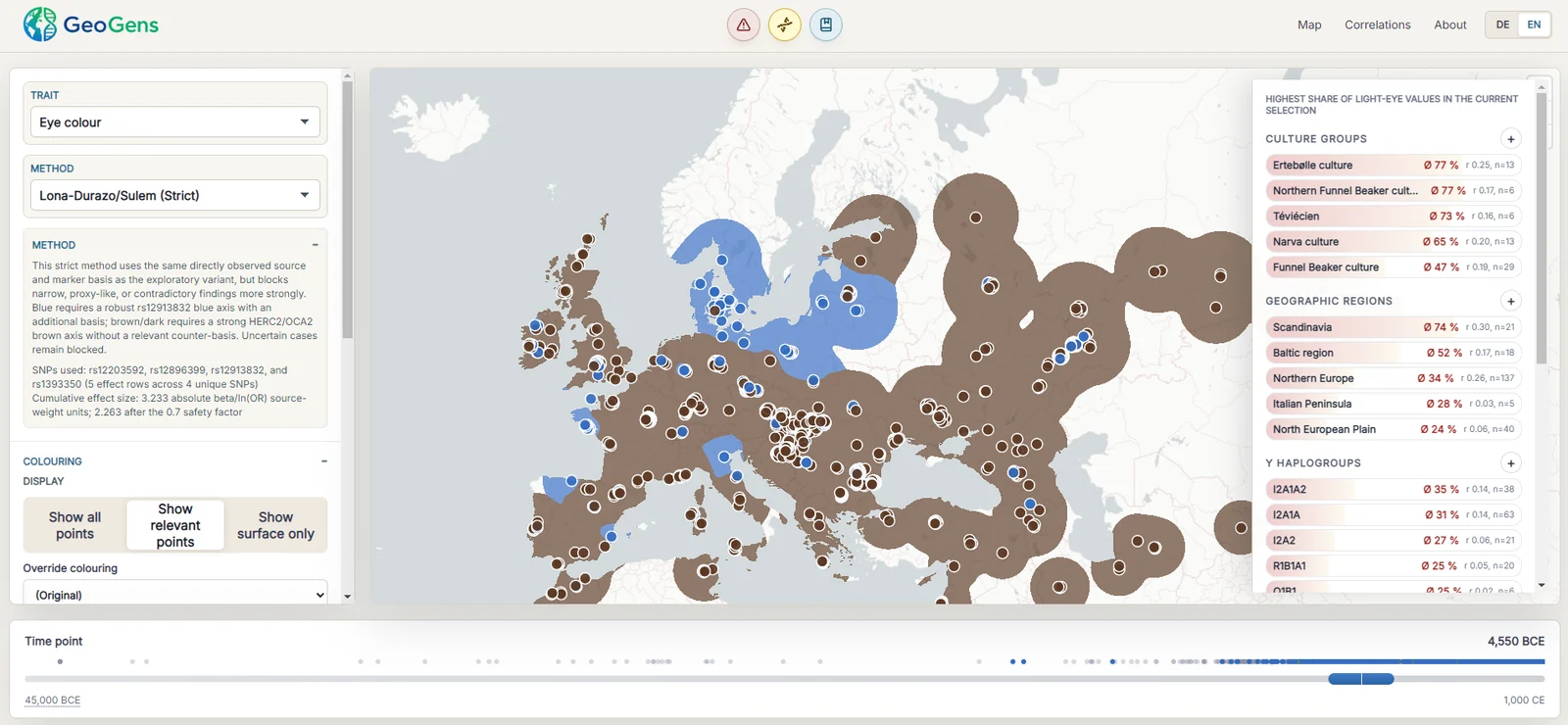
Check the genetic evidence - online right now!

The software GeoGens plots several thousand published ancient genomes in space and time, with their haplogroups, traits and relatedness.

Publication is a long way off. Spend some of the wait in the evidence.

geogens.euThe GeoGens map view: eye colour plotted across Europe at around 4,500 BCE, with a panel listing the culture groups, regions and Y haplogroups that carry the highest share of light-eye values in the current selection.
GeoGens, showing inferred eye colour across Europe at around 4,500 BC and the groups that carry it.

Pre-order

Western Origins

Indo-European Homeland, Expansion and Character

  • Hardcover, sewn
  • approx. 250 pages
  • approx. 50 maps, black and white
  • dispatched May 2027
Format
Deliver to
Shipping — US & Canada$14.00
Copies
1 × Western Origins$28.00
Total$42.00

The book is posted from Germany in May 2027, and we write to you first so you can correct the address. Cancel any time before it is sent and the full amount, shipping included, comes back.

No VAT is shown or charged: the seller applies the small-business rule under § 19 UStG.

Hardcover, 1 copy to United States & Canada. Total $42.00.

Not ready yet?

We will email you once when the book is published, so you can order then if you like.

Follow the work

Questions

How pre-order works

Can I cancel any time?

Any time before the book is posted or the file is sent, for any reason or none. Write to contact@western-origins.com and the full amount comes back, any shipping included.

That is a promise we make, and it is wider than the law requires. The statutory fourteen-day right of withdrawal runs from delivery for the printed book and from the day you order for the e-book — so for a pre-order this contractual right is the one that actually matters.

What is the difference between the two editions?

The hardcover is the printed object, sewn, around 250 pages, posted from Germany. The e-book is the same text and the same maps as an EPUB file, emailed on publication, with no shipping to pay.

Will the e-book work on my Kindle?

Not by copying the file across by hand — Amazon does not accept a sideloaded EPUB the way people often expect. Amazon's own Send to Kindle will take it and convert it, which works. On Kobo, Tolino, PocketBook, Apple Books, Google Play Books and any desktop reader it simply opens.

When exactly will it ship?

The printed edition in May 2027, from Germany, as soon as the print run arrives. The e-book is emailed the same month; nothing is sent before then.

You get an email a few weeks beforehand to confirm your address. Nothing is sent to an address we have not checked with you.

How do I know my payment is safe?

Payment runs through Stripe. Card details are entered on Stripe’s own page and never reach this site.

The author

Linus Ammer

studied prehistory and linguistics in Germany and Austria. He is an independent researcher and software engineer.

After writing the first edition of “Western Origins” in German, he built “GeoGens”, a visualisation platform for the public archaeo-genetic data. When the results confirmed a lot of his assumptions, he rewrote the book in English for a wider audience, including all the newest genetic data.

Also by the author, in German

  • 2022Die Herkunft der Indogermanen und Germanen
  • 2024Das alte germanische Recht
  • 2025Indogermanen: Herkunft, Eigenschaften, Expansionsgeschichte